

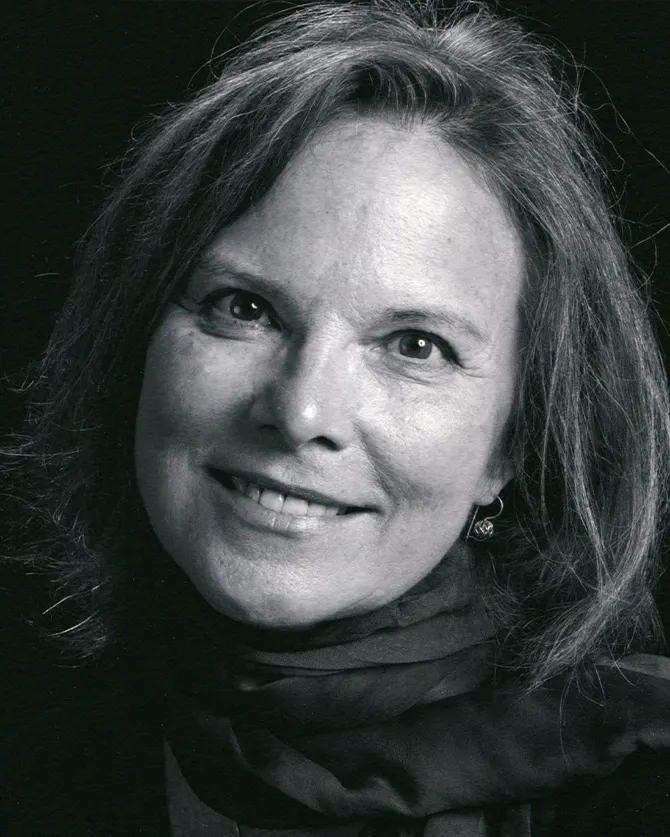
Carolyn Forché
Poet and human rights activist. Carolyn Forché is the author of several poetry collections, including Gathering the Tribes, The Country Between Us, The Angel of History, and Blue Hour. Two poetry anthologies edited by her, Against Forgetting: Twentieth-Century Poetry of Witness and Poetry of Witness: The Tradition in English, 1500–2001, became bestsellers. The poet has been frequently nominated for various awards and has received numerous honors, including the Edita and Ira Morris Hiroshima Foundation for Peace and Culture Award in Stockholm, a Guggenheim Fellowship, a Lannan Literary Fellowship, and most recently, in 2014, the Academy of American Poets Fellowship.
For over forty years, Carolyn has taught literature and writing at various universities, and has given readings of her poetry across the globe. Her work has been translated into more than twenty-five languages. Carolyn Forché is a Professor at Georgetown University, where she also directs the Lannan Center for Poetics and Social Practice.
Carolyn Forché’s participation in the Tbilisi International Literature Festival is supported by the U.S. Embassy in Georgia.
The Colonel
What you have heard is true. I was in his house. His wife carried a tray of coffee and sugar. His daughter filed her nails, his son went out for the night. There were daily papers, a pet-weight copter on a little cushion, a giant television set. Silent copters hovered above them like insects. The walls were studded with embedded glass, so that no one could climb over them. The windows were barred like a local liquor store.
We had dinner: rack of lamb, good wine, a gold bell on the table to call the maid. The maid brought green mangoes, salt, a local bread. They asked me how I liked the country. The television screen flashed a commercial in Spanish. His wife cleared the dishes. Then they talked about how difficult the country had become. A parrot on the terrace said something. The colonel told it to shut up and got up from the table. My friend signaled with his eyes for me to remain silent.
The colonel returned with a sack of common cloth. He spilled many ears onto the table. They looked like dried peach halves. There is no other way to say this. He took one of them in his hand and shook it in our faces. He dropped it into a water glass. It came alive there. I am tired of fooling around, he said. As for the human rights… tell your bosses, to hell with them! He swept his arm across the table and pushed the ears to the floor. Then he raised his wine glass. Something for your poetry, no? he asked. On the floor, some of the ears caught the scrap of his voice. Some of the ears on the floor were pressed to the ground.
Translated from English by Dalila Gogia